CRYOGENIC
Hazard description
Cryogenics is the science and technology of low temperatures (< -150oC or 120K).
At room temperature, cryogens are in gaseous state. At extremely low temperatures, they are liquid.
The most commonly cryogenic fluids used at CERN are argon, helium and nitrogen. They are odourless, colourless and tasteless.
- Argon: heavier than air, boiling point 87 K (atm. pressure)
- Helium: lighter than air, boiling point 4K (atm. pressure)
- Nitrogen: heavier than air, boiling point 77K (atm.pressure)
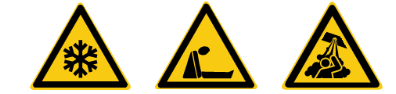
The main hazards of these cryogens are:
- Physiological: cryogenic burns to skin and eyes, lung lesions, asphyxia
- Physical: explosion caused by over-pressurisation of a cryogenic device (malfunction of safety accessories), equipment damages due to low temperature, oxygen enrichment around cold surface
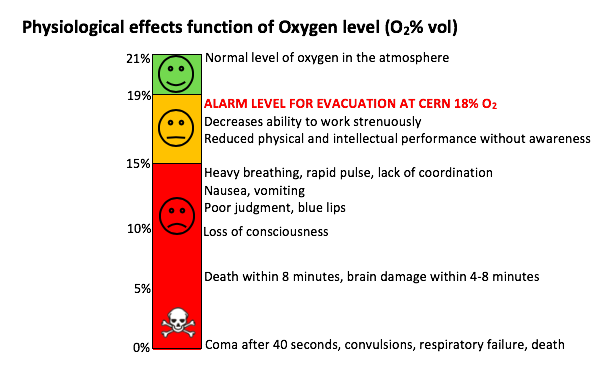
- Oxygen Deficiency Hazard (ODH)
Contact
CERN Safety Rules and related documents
The CERN Safety documents concerning the cryogenic hazards are the following:
- General Safety Instruction GSI-M-4 : Cryogenic equipment
- Safety Guidelines SG-M-4-0-1: Cryogenic equipment
Other documents related to cryogenic hazards
Training courses
On the CERN’s Learning Hub